National Treasure

Buddhist Teachings for the Monk Teki Zōsu
的蔵主あて進道語
Calligraphy & Books · Nanbokuchō, 1341TNM
Home › Browse › Calligraphy & Books › Nanbokuchō period › Buddhist Teachings for the Monk Muin Genkai

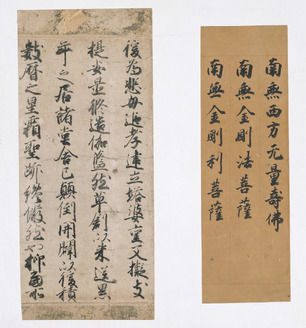
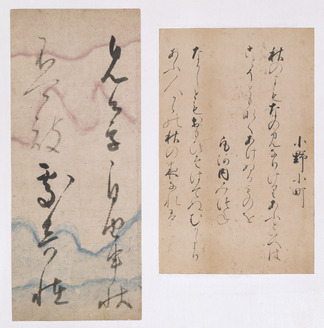
Feng Zizhen wrote these Buddhist teachings for the visiting Japanese monk Muin Genkai. This style of calligraphy was popular in Yuan-dynasty (1271–1368) China, but few examples were transmitted to Japan. Feng Zizhen wrote this poem in accomplished calligraphy for the Japanese Zen monk Muin Genkai. The characters have long horizontal lines stretching to the left, and sharp lines with sweeping strokes and flicks. The use of the brush is lively and crisp, and resembles the work of Huang Tingjian, a Chinese calligrapher active during the 11th- and 12th-century Northern Song Dynasty. The shapes of the characters are quite bold, with the white spaces in them varying distinctly from small to large in size. The author, Feng Zizhen, was a bureaucrat who had served the Yuan-Dynasty government as a civil servant. He was well versed in history and the Confucian class, and also excelled in poetry and calligraphy. While Feng Zizhen did not become a monk, he did participate in Buddhist practices and enjoyed close relationships with many well-respected monks, including Zhongfeng Mingben and Gulin Qingmao. Muin Genkai, the recipient of this work, was a Zen Buddhist monk from the area of Buzen, which is now the eastern part of Fukuoka prefecture, and the northern part of Oita prefecture. He traveled to China for Buddhist training, and studied under Zhongfeng Mingben.
After completing over fifteen years of training, he returned home to Japan, and would go on to serve as chief priest of Buddhist temples in Hakata, Kamakura, Kyoto, and other areas. It is stated in the poem that Muin Genkai studied under Zhongfeng Mingben, and that he excelled as a Zen Buddhist monk. It is thought that Feng Zizhen wrote and sent this poem when Muin Genkai was returning to Japan, so that he could take it back with him. Following this, from the 18th century to the 19th century, it was held by Matsudaira Fumai, who was the feudal lord of Matsue, a feudal domain located in modern-day Shimane prefecture. Fumai was also a renowned tea master; he treasured the piece as a wall decoration in his tea ceremony room. It is registered in a catalogue of tea implements Fumai owned, and from the text we know that the cloth backing and case of the scroll remain in the same state as it was when Fumai possessed it. Although Feng Zizhen was a practitioner of Buddhism who never became a monk, the scroll was brought to Japan by a monk who had gone abroad to China to study and was treated as though it were written by a Zen monk. After this, the scroll was treasured within the culture of tea ceremony.
— Museum description: Tokyo National Museum (CC BY 4.0), via ColBase / Japan Search.