National Treasure

Cinerary Urn
瑠璃骨壺
Archaeological Objects · Asuka, 707TNM
Home › Browse › Archaeological Objects › Nara period › Cinerary Urn of Ihokibe no Tokotarihime
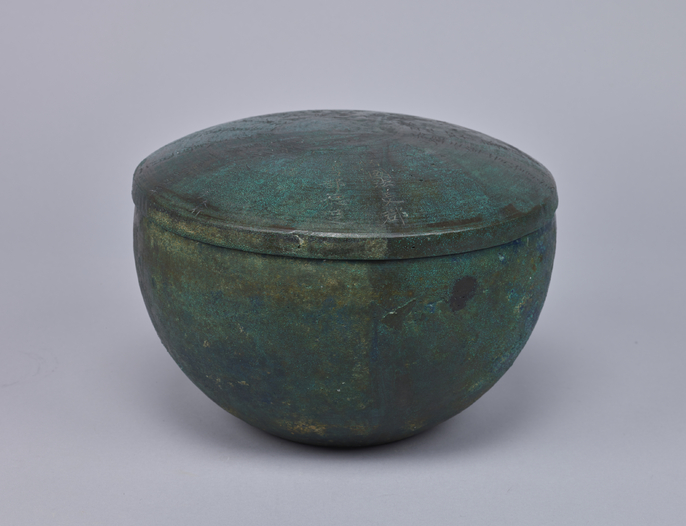
The tombs of emperors, powerful families, and other members of Japan's ruling class changed substantially from the late-7th century to the Nara period. The large kofun tumuli of earlier generations now disappeared as tombs grew smaller in scale, with burials also replaced with cremations, a new custom that arrived on Japan's shores alongside Buddhism. This is a metal cinerary urn. It has a rounded shape and a hollowed-out flat base for added stability. A glance at the lid reveals streaks of patina running towards the center. These are probably signs of where the urn was tied up in cruciform fashion using rope. Traces of calcium from bones were also found inside the vessel. This urn also serves as an epitaph. Epitaphs were inscribed with the name, rank, and details of the deceased and they were buried inside tombs. Some were carved on rectangular plates while others were engraved on cinerary urns, as with this example.
There is a 108-character 16-line inscription carved in a radial pattern on the lid. This reveals how the urn housed the remains of Ihokibe no Tokotarihime, a woman appointed to the official rank of Jushichii-ge by Emperor Monmu. It also states how she passed away in 708 before being cremated two years later. Only 15 such epitaphs have been found in Japan so far. Of these, only two were for women, including this example. Ihokibe no Tokotarihime was interred with great care in a very modern style for her day, so she was clearly a woman with a close connection to Japan's central government. Found inside a stone coffin in 1774, this cinerary urn was for a female member of the Ihokibe clan. The clan held power in the region and took charge of rituals held at a local shrine. The urn's lid bears a 108-character inscription in 16 lines.
— Museum description: Tokyo National Museum (CC BY 4.0), via ColBase / Japan Search.