National Treasure

"Expedient Means" Chapter of the "Lotus Sutra" (From Chikubu Island)
法華経 方便品(竹生島経)
Calligraphy & Books · Heian, 11th centuryTNM
Home › Browse › Calligraphy & Books › Heian period › Engishiki (Rules and regulations concerning ceremonies and other events)
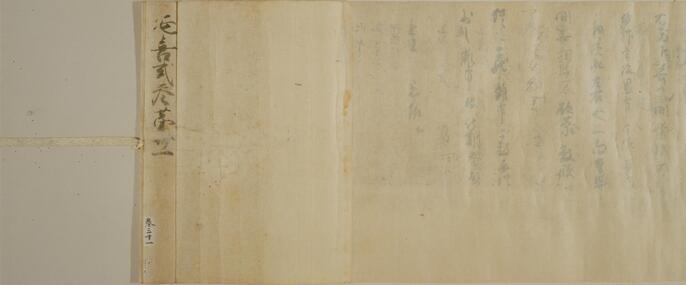
In the latter half of the 7th century, Japan introduced a legal system based on Chinese law. The system was known as ritsuryo. 'Ritsu' refers to criminal law while 'ryo' refers to other non-criminal laws. However, many aspects of the system did not fully accord with Japanese society, so supplementary laws known as kyaku were also created. The detailed rules and regulations necessary for implementing all these laws were called shiki. These regulations were revised and supplemented to meet societal changes several times throughout the Heian period, which lasted from 794 to 1192. One product of this process is the Engishiki. This set of rules and regulations concerning ceremonies and other events began to be compiled by order from Emperor Daigo in 905, or Engi 5. Only a small section of the shiki regulations from before this time still exist, but the Engishiki has survived essentially intact, making it an invaluable historical document. This is a transcription of the original Engishiki.
It is the oldest extant transcription and it was handed down through the Kujo family, one of the houses of the Fujiwara, an aristocratic clan that wielded power during the Nara and Heian periods. The Engishiki originally comprised 50 scrolls. Of the 27 extant scrolls, all but one were transcribed in the late Heian period. Close to half of the Engishiki is concerned with regular annual ceremonies and other events. As such, court officials used it as a valuable source of information about the dates and details of these events. It is thought this transcription was also copied out to record these events. This version was probably owned by successive heads of the Kujo family. It is written using standard, square-style Chinese characters, so readers of Japanese or Chinese may be able to find some proper nouns they recognize. The enjoyment of this historical document can be enhanced by imagining how it was originally used, for instance, or by trying to spot some familiar names.
— Museum description: Tokyo National Museum (CC BY 4.0), via ColBase / Japan Search.


