National Treasure

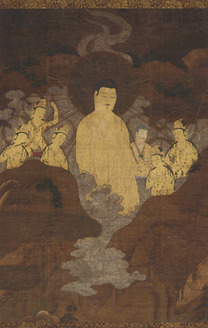
Bishamon Ten (Vaiśravaṇa), Extermination of Evil (J., Hekija-e)
辟邪絵 毘沙門天像
Paintings · Heian, 12th centuryNara NM
Home › Browse › Paintings › Kamakura period › Śākyamuni Triad

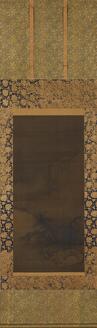
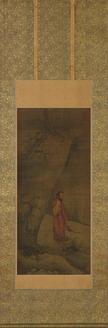
{i=>[seppōin, nyoi, kesa], content=>[Shaka (Skt. Śākyamuni), the historical Buddha, forms a ritual gesture known as the “preaching mudra” (J. , ). Shaka is flanked by two attendant bodhisattvas: Monju (Skt. Mañjuśrī), who is seated on a lion and holds a scepter (J. , ), and Fugen (Skt. Samantabhadra), who is seated on an elephant and holds a lotus flower. The strong influence of Song-dynasty Buddhist painting is seen in the placement of the figures on clouds, the facial features of Shaka, and in the fact that Monju wears a Buddhist surplice (J. , ).]} The central hanging scroll of this triptych features the Buddha Shakamuni (Skt. Śākyamuni). He is flanked by the bodhisattvas Monju (Skt. Mañjuśrī) riding a lion and Fugen (Skt. Samantabhadra) riding a white elephant to form a three-scroll triad. Monju and Fugen are each joined by an attendant; these figures seem to be from South Asia. This is believed to be a copy of a painting brought to Japan from China. {br=>[[], []], content=>[Shaka-nyorai (Śākyamuni), sitting cross-legged on the lion-seat, is painted in the center scroll. He is making the finger sign \Seppō-in\ (sign of sermon) and is bearing round halos. In the side scrolls, Monju-bosatsu (Mañjuśrī) is riding on lion-back, holding a nyoi stick in his hand, and Fugen-bosatsu (Samantabhadra) is riding on the back of a white elephant with a lotus flower in his hand., Shaka-nyorai is depicted in a unique style: the top of his head is not raised very high, the face is rather long, eyebrows and eye lines are curving sharply, two short lines are drawn at the ridge of the nose, and finger nails are long.
Iconographically and technically, the influence of Buddhist paintings of the Song and Yuan dynasties can be observed in this set of paintings—such as the ornamental crowns of Monju-bosatsu and Fugen-bosatsu, the peculiar style of the saddles, the kesa-robe of Monju-bosatsu, and the fine decoration of the costume rendered in gold pigment. Shaka's body is painted in gold and outlined in red. Monju-bosatsu and Fugen-bosatsu are painted partly in yellow and partly in white. The technique of painting in gold over the first coat of white wash used in these paintings was later adopted by the artists of the Nanboku-chō period., One of the most notable aspects of these three paintings is that all three figures are painted on a cloud as if they were floating upward into the air. This expression is considered as an illustration of Shaka's sermon in the air, and therefore the relationship between these paintings and the Hoke-kyō (Lotus sutra) can be conjectured.]}
— Museum description: Nara National Museum (CC BY 4.0), via ColBase / Japan Search.