Important Cultural Property
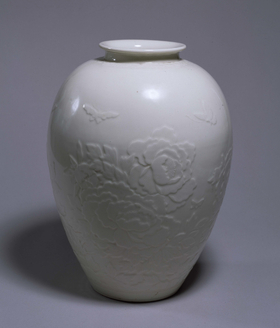
Large Vase with Butterflies and Peonies
白磁蝶牡丹浮文大瓶
Ceramics · Meiji and later, 1892TNM
Home › Browse › Ceramics › Meiji and later period › Large Vase with a Plum Tree

This large vase features a monotone plum tree design that resembles a monochrome ink painting. The lower section bulges out gently while the upper section tapers elegantly. The white vase was created by applying a glaze-filled liquid and then firing the object in a kiln. Detailed motifs like the branches and flowers of the plum tree were then painted using pigments with high iron contents. A yellowish glaze was applied in the outer sections of the motifs presumably around the time when they were painted, and the vase was fired again, although this whole process of making this vase is not totally definite. The pretty buds and the supple branches are rendered with a masterful touch. The white plum blossoms also bloom vividly against the yellow ground. Miyagawa Kozan was born in Kyoto at the end of the Edo period.
During the Meiji era, he began producing ceramics for export in Yokohama. This vase was submitted to the Chicago World's Columbian Exposition in 1893. Its clearly-defined shape and advanced glazing techniques borrowed heavily from Chinese pottery, which was popular in the West at that time. The world was captivated by this highly-accomplished vase, a product of Kozan's supreme talents as a ceramicist. The ceramic artist Miyagawa Kōzan I (1842–1916) exhibited this flower vase at the Chicago World's Fair in 1893 to great acclaim. The surface decoration showcases his mastery of brush painting and advanced glazing techniques, which he developed through his study of porcelain from Qing-dynasty China (1644–1912).
— Museum description: Tokyo National Museum (CC BY 4.0), via ColBase / Japan Search.