National Treasure

Hue of the Water, Light on the Peaks
山水図(水色巒光図)
Paintings · Muromachi, 15th centuryNara NM
Home › Browse › Paintings › Nanbokuchō period › Mandala of Sannō Miya Shrine
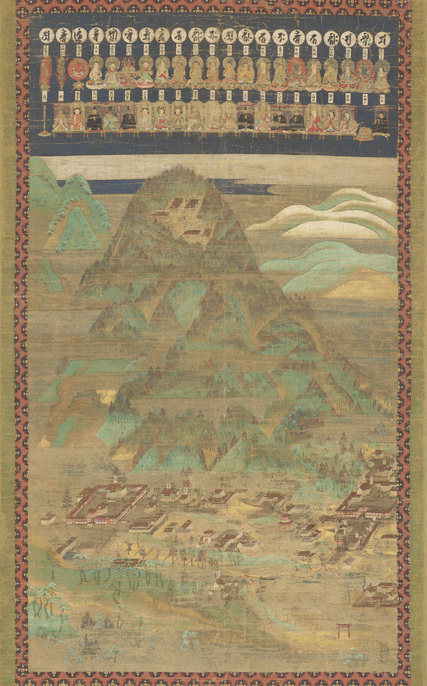
{i=>[chinju, honji butsu], content=>[Major temples are often protected by Shinto deities in a shrine (, ) on or near their grounds. This votive painting depicts the environs of Sannōsha Shrine (also known as Hie Taisha Shrine) in the eastern foothills of Mount Hiei, a shrine that houses the kami who guards over the mountain and Enryakuji Temple. The upper portion of the painting shows the twenty-one Shinto deities of Sannō enshrined here, as well as each deity’s Buddhist form (, ). This painting comes from Mount Hiei.]} This is one of the so-called shrine mandalas which depicted the views of shrines and were used at worship services. Twenty-one sanctuaries of Sannō shrine on Mt. Ushio are described. The shape of the mountain is expressed in a romantic manner with a lot of mist and haze, whereas the buildings are depicted precisely and are well distinguished from the landscape.
The name of each sanctuary is written in a tanzaku-shaped rectangular space next to each sanctuary building. This fact indicates that the artist put more emphasis on reality rather than on the mysteriousness of the shrine. In the upper part of the scroll, twenty-one Shintoist deities, the same number of Buddhist deities corresponding to the above-mentioned Shintoist deities, and their holy letters are depicted, because this scroll was a major object used for worship services. In this picture, the existence of Shintoist deities, who were thought to be transformed images of Buddhist deities, are emphasized by describing the real view of the shrine as a major motif. Judging from the decoration, which extends continuously from the picture to the mounting, this painting has been mounted as a hanging scroll from the beginning. This is another noteworthy aspect of this work.
— Museum description: Nara National Museum (CC BY 4.0), via ColBase / Japan Search.


