Important Cultural Property
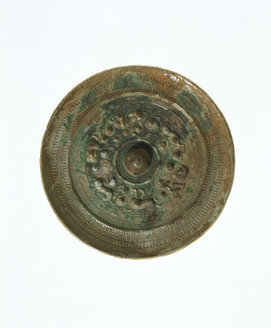
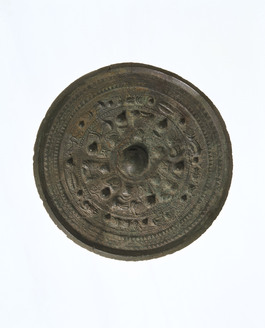
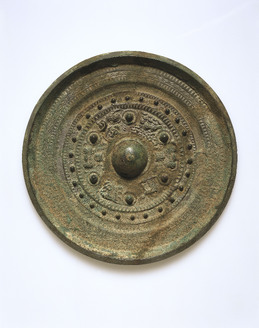
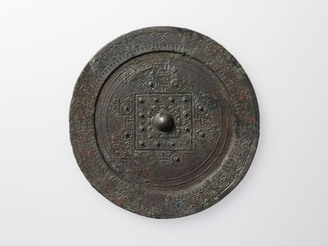
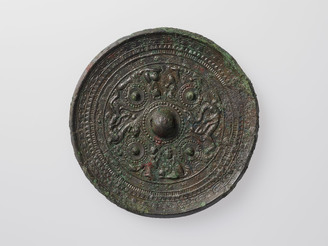
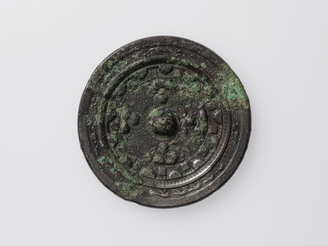
Mirror (Excavated from Samida Takarazuka tumulus, Nara)
斜縁神獣鏡(奈良県佐味田宝塚古墳出土)
Archaeological Objects · Kofun, 301–500Nara NM
Home › Browse › Archaeological Objects › Kofun period › Objects Excavated from Samida Takarazuka tumulus, Nara

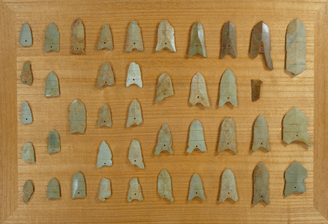
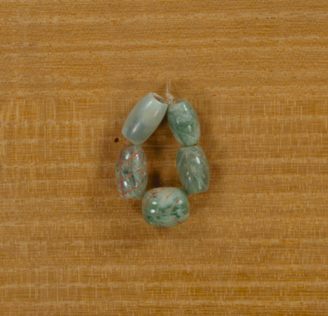
{br=>[[], [], [], []], i=>[yinyang wuxing, Triangular-Rimmed Mirror Decorated on the Back with Gods, Divine Beasts, and a Cabriolet, gazō kyō], content=>[The Samita Takarazuka Tumulus is a massive keyhole-shaped burial mound located in present-day Samita, Kawai Town, Kita-Katsuragi District, Nara Prefecture. It occupies a central position in the Umami Tumulus Cluster, which spreads across the western part of the Nara Basin. The tumulus is 111.5 meters long with a 60-meter diameter in the circular portion and a mound height of 8 meters. The circular part was excavated by local residents in 1881 (Meiji 14). They discovered a wealth of artifacts, including mirrors, beads, and stone objects carved to look like a variety of weapons and ritual objects. At present, the artifacts are divided among the Imperial Household Agency’s Archives and Mausolea Department, the Tokyo National Museum, and the Nara National Museum. The three mirrors shown here with deities and divine beasts on the back are owned by the Nara National Museum., The mirrors’ designs come from early Chinese iconographies rooted in the pursuit of immortality and the doctrine of Yin-Yang and the Five Elements (, ). Such mirrors were primarily produced in China’s Jiangnan Province from the Eastern Han dynasty (25–220) to the Northern and Southern dynasties (420–589), particularly during the Three Kingdoms period (220–280). Among those found in Japan, some were brought from China and others were made domestically based on Chinese examples. Archaeologists call them “triangular-rimmed mirrors with gods and divine beasts” in reference to their flared rims that appear triangular in cross-section. They are also known for their wide bands of sawtooth patterning and wavy lines in their outer sections. Some scholars have suggested these are the type of mirror referred to in Chinese historical sources as having been presented to Queen Himiko of the Yamatai Kingdom by the Chinese state of Wei., Alt hough the shapes of the rims and motif compositions have minor deviations, these three are largely typical examples of such mirrors: The inner sections have six bosses placed between alternating motifs of dragon-like beasts, divine immortals, and attendants.
The outer sections have bands containing inscriptions or narrow bands containing pictorial motifs like fish, lizards, and birds. These mirrors were probably produced in Japan rather than China. This is suggested by the inferior quality of the casting, the simplified designs, and imperfections in the molds. , Among the three mirrors, the , notably has a cabriolet (two-wheeled chariot) placed among the deities, beasts, and a mountain range in the inner section. This cabriolet is thought to be a vehicle for an immortal. Depictions of cabriolets are usually only found on a type of mirror with legendary figures from ancient China on the back that Japanese archaeologists call , . The mirror in the Nara National Museum’s collection is a rare and valuable example of such a motif found on a “triangular-rimmed mirror with gods and divine beasts.” The mirror’s band with Chinese phrases inscribed in it has those found on both types of mirrors, such as “尚方作竟真大好,”上有仙人不知老” and “保子宜孫寿如金石.” These appear to refer to the mirror’s production and immortals dwelling above who “live as long as metal and stone.” , When the Samita Takarazuka Tumulus was first excavated, 36 mirrors were reportedly found there, though only 26 remain extant today. This is the third largest number of mirrors to be found in a burial mound in Japan. A well-known mirror owned by the Imperial Household Agency’s Archives and Mausolea Department has images of house-like structures on the back, offering valuable pictorial representations of Japan’s early residential architecture. ]}
— Museum description: Nara National Museum (CC BY 4.0), via ColBase / Japan Search.