National Treasure
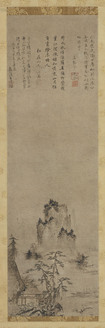
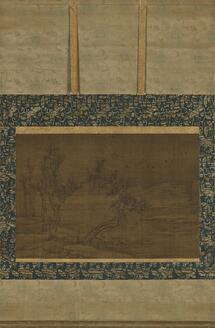
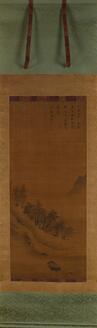
Hue of the Water, Light on the Peaks
山水図(水色巒光図)
Paintings · Muromachi, 15th centuryNara NM
Home › Browse › Paintings › Nanbokuchō period › Portrait of the Priest Daoxuan (Dōsen)

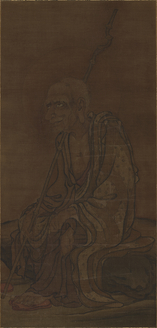
This is a portrait of the Tang-dynasty high priest Daoxuan (J. Dōsen Risshi; 596–667), the patriarch of the Buddhist Lu (Ritsu) sect in China. It is very similar to the portrait of Daoxuan enshrined at Sennyūji Temple in Kyoto that was produced during the Southern Song dynasty in 1210 (Jiading 3). That portrait became the orthodox way of depicting him, and one encounters versions sharing in its visual traditions at Ritsu-sect temples in some parts of Japan. {br=>[[]], content=>[Priest Dōsen (Daoxuan) of the Nanzan (Nanshan) school (596-667), who lived on Mt. Zhongnan-shan, was a scholar of the Buddhist precepts in the early Tang dynasty. Having edited a book of Buddhist precepts, titled \Shibunritsu gyōji-sho\ (or a book of Four-parts Vinaya), he was respected as a patriarch of the Nanzan school of Buddhist precepts. He was translating Buddhist scriptures into Chinese under the instruction of Priest Genjō and was writing many historical records and other documents as well. Priest Ganjin introduced the Four-Parts Vinaya to Japan during the Nara period. Later on, during the Kamakura period, there was a movement to revive the idea of the Four-Parts Vinaya in Nara and in Kyoto., Portraits of Priest Dōsen have been known in Japan since the early days.
It is conceivable that the portrait introduced in this article was modeled after one of the Dōsen portraits in the Song dynasty. There is one Dōsen portrait of the Song dynasty kept in Sennyū-ji temple which Priest Shunjō brought to Japan in 1210, and the composition of the Dōsen portrait discussed here is quite similar to the composition of the portrait in Sennyū-ji temple. Dōsen portrait paintings represent one of the genuine portrait styles of the Song dynasty, just as Zen patriarchs' portraits are representative of another portrait style of the Song dynasty. The flat-crowned head and the characteristic eyebrows are depicted by fine brush strokes in ink. Shading in ink is added along the drapes of the kesa-robe. The portrait is carefully painted in rich colors, and the costume under the robe is decorated with the colorful design of Shippō-tsunagi. The description is excellent and is rendered in detail. It is notable that this portrait clearly reflects the painting style of the Song dynasty in China although it was painted in Japan.]}
— Museum description: Nara National Museum (CC BY 4.0), via ColBase / Japan Search.