Important Cultural Property

Crown
天冠
Textiles · Nanbokuchō, 14th centuryTNM
Home › Browse › Textiles › Nanbokuchō period › "Ryoto" (Bugaku costume), Design of a double-vine peony arabesque in gold brocade on a dark blue ground
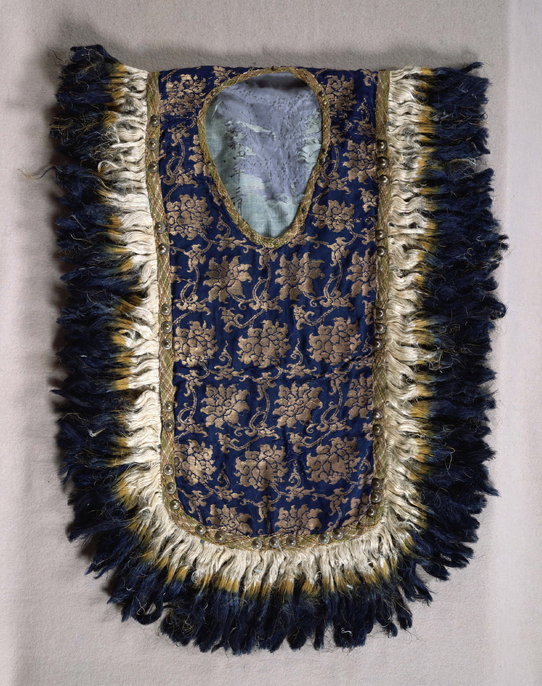
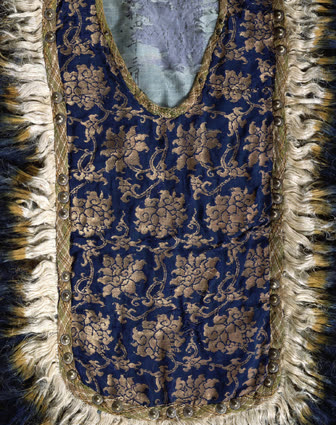
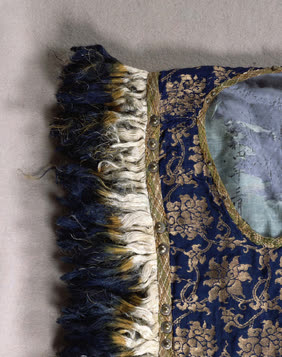
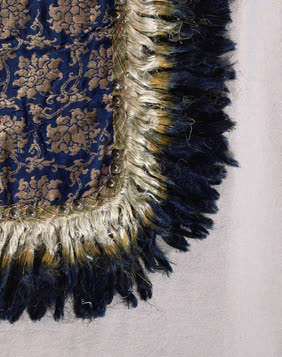
Made with gold brocade imported from Yuan-dynasty China, this costume was donated to the Niutsuhime Jinja shrine in 1378. This is a costume for the performing art of bugaku, which is an ancient dance that accompanied music performed at the imperial court, temples, and shrines, from the Heian period onward. A ryoto is a long vest-like garment that was worn for intense dances called hashirimai. This ryoto features a design of peony arabesques in gold brocade on a glossy satin ground. It was not possible to produce this type of brocade in Japan at the time, so the textile was imported from Yuan-dynasty China.
Moreover, the lining features an inscription stating that this ryoto was offered to a shrine in the year 1378. This precise dating makes this an extremely valuable garment. Now take a look at the tassels around the edges. The parts near the edges are made of processed silk, while the ends are raw silk, which is stiff and does not have a luster. This gives the tassels a wild texture like the fur of an animal. Japan had no tradition of wearing animal fur, so this technique created a kind of artificial fur, the wild look of which would have been perfect for the intense dances this ryoto was worn for.
— Museum description: Tokyo National Museum (CC BY 4.0), via ColBase / Japan Search.