National Treasure

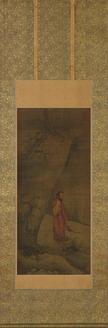
The Eccentrics Hanshan and Shide (From a Scroll of Zen Paintings)
寒山拾得図(禅機図断簡)
Paintings · Nanbokuchō, 14th centuryTNM
Home › Browse › Paintings › Nanbokuchō period › The Four Sleepers

The four sleepers are a common motif in Chinese painting. The title refers to three humans sleeping together with a tiger. The person in the back is Fenggan, a Zen Buddhist monk from the Tang dynasty (618–907), who purportedly domesticated a tiger. The two people leaning on each other in the front are Hanshan and Shide, two followers of Fenggan. The curious behavior and expressions of these two are due to the fact that they're in a place beyond the secular world; they are Zen saints. The facial features and hair of the figures, as well as their clothing, have been depicted with fine ink lines painted with a sense of tension. This monochrome ink-line drawing style is referred to as hakubyo in East Asia. Hakubyo was popular with the scholarly class in China for its aesthetics, and by Zen Buddhists, who had similar tastes. In the 14th century, during the Yuan dynasty (1271–1368), a lacework-like, delicate style of polished hakubyo became popular. This work was part of that movement. The skill of the painter can be seen in the separate, carefully drawn strands of the hair and eyebrows of the figures, and in the depiction of the tiger's hair.
The painting style used for the stones in the background, the layers of fine wavy lines on the ground, the small whirls filling in the trunk of the pine, and the mist shaped like mushrooms evoke styles of the Tang and Song (960–1279) dynasty styles. They provide the painting with a refined classical atmosphere. On the upper part of the painting, well-known Zen Buddhist monks of the Song dynasty, Pingshi Ruzhi, Huaguo Ziwen, and Mengtang Tan’e, inscribed poems related to the theme of the four sleepers, making this painting a precious work of Zen-Buddhist calligraphy as well. It’s possible that this painting was brought to Japan in the 14th century, when many Japanese Buddhist monks traveled to China to study Zen. The Four Sleepers shows Fenggan, a Zen monk from the Tang dynasty (618–907) who domesticated a tiger. The two figures sleeping in front of the tiger are his disciples Hanshan and Shide.
— Museum description: Tokyo National Museum (CC BY 4.0), via ColBase / Japan Search.