National Treasure
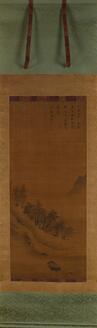
Hue of the Water, Light on the Peaks
山水図(水色巒光図)
Paintings · Muromachi, 15th centuryNara NM
Home › Browse › Paintings › Nanbokuchō period › Water Moon Kannon (Avalokiteśvara)
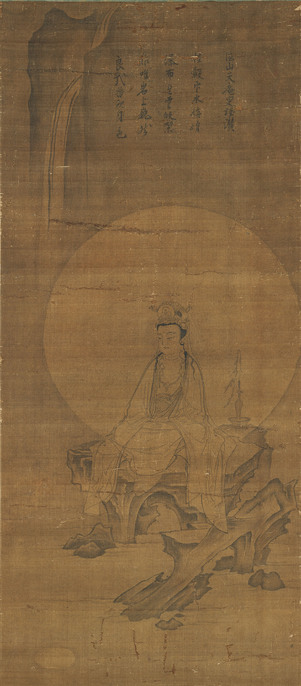
This painting expresses an iconography prevalent throughout East Asia in which the bodhisattva Kannon (Skt. Avalokiteśvara) gazes upon the reflection of the moon in the water’s surface. The inscription at the top of the painting was left by Ten’an Myōju (dates unknown), a high-ranking Zen priest at such institutions as Nanzenji Temple. The last line (reading left to right) begins with “Tokuzan,” or “Mountain of Merit”—an epithet for Ankokuji Temple (Ayabe City, Kyoto prefecture) in what was then Tanba Province. Ankokuji was founded during the Kenmu era (1334–1338), so Tenan’s reference dates his inscription to around that time or later. {br=>[[]], content=>[The painting depicts the “water moon” iconography of the bodhisattva Kannon (Skt. Avalokiteśvara). In it, Kannon gazes serenely at the moon’s reflection in the water to the lower left, and a willow branch is inserted in the nearby water pitcher. The deity is shown with a circular halo while sitting on a rock rising from the water. A waterfall is visible along the cliffs in the upper part of the background. This iconography differs from that of the White-Robed Kannon seen in the Hall of the Lotus Division (J. Rengebu-in) of the Womb World Mandala and seems to have first appeared in Chan (J. Zen) temples during the Southern Song dynasty (1127–1279). Many such paintings were produced from then through the Yuan (1271–1368) dynasty in China and from the Kamakura period (1185–1333) onward in Japan., The inscription was written by Ten’an Myōju (d.
1345), a priest in the Bukkō lineage of the Rinzai (Ch. Linji) school and a disciple of Kōhō Kennichi (1241–1316), who had been a leading disciple of the Bukkō lineage’s founder Wuxue Zuyuan (1226–1286), a Chan master from China . Myōju was the abbot of Jōchiji Temple and Manjuji Temple in Kamakura and Shinnyoji Temple and Nanzenji Temple in Kyoto. He also founded Ankokuji Temple in Tanba Province (now part of Hyōgo Prefecture) around the Kenmu period (1334–1338). He passed away in Jōwa 1 (1345) at the age of 79. The reference to “Toku-zan” in the inscription refers to Ankokuji’s honorific name—Keitoku-zan. This has allowed scholars to date the painting to around the Kenmu period, when Myōju was active at Ankokuji. The work is thus one of Japan’s earliest extant ink paintings. At the time, traditional iconographies were being adapted to incorporate ink-painting techniques, such as the Eleven-Headed Bodhisattva Kannon (J. Jūichimen Kannon; Skt. Ekādaśamukha-avalokiteśvara) and Nyoirin Kannon (Skt. Cintāmaṇicakra), but other iconographies were being developed specifically for ink painting, like the White-Robed Kannon, which presumably originated in Zen temples. The style and degree of polish seen in these paintings differ significantly depending on the artist. This particular work was produced during a transition period, before ink painting had come into its own in Japan, and retains elements from traditional Buddhist painting in the line work and ink expressions. ]}
— Museum description: Nara National Museum (CC BY 4.0), via ColBase / Japan Search.