National Treasure

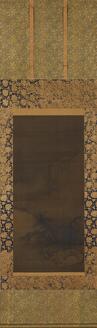
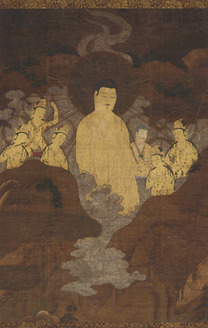
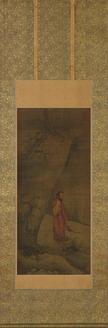
Bishamon Ten (Vaiśravaṇa), Extermination of Evil (J., Hekija-e)
辟邪絵 毘沙門天像
Paintings · Heian, 12th centuryNara NM
Home › Browse › Paintings › Kamakura period › White-Robed Kannon (Pāṇḍaravāsini)
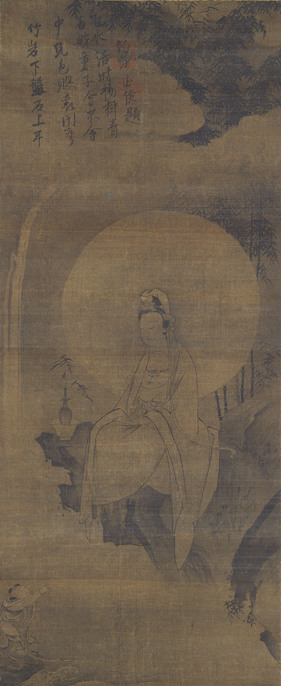
{i=>[Flower Garland Sutra, Buddhâvataṃsaka-sūtra, Huayan jing, Kegon kyō], content=>[Part of the , (Skt. , ; Ch. , ; J. , ) describes the pilgrimage of the child Sudhana (Zenzai Dōji) to study the Dharma with spiritual teachers in his quest to reach awakening. His meeting with the bodhisattva Kannon (Skt. Avalokiteśvara) is depicted in this painting, which is one of the earliest ink monochrome works done in Japan. The inscription is by Yakuō Tokuken (1245–1320), who went to China and trained at the important temples Ayuwangsi (Aikuōji) and Tiantongsi (Tendōji). On his return to Japan, he became a high-ranking Zen priest at Nanzenji and other institutions.]} This is a painting of Kannon (Avalokiteśvara) in a white garment sitting on a rock. It can be inferred from the little boy depicted at the lower part of this painting that the motif of this paintings is the scene from the Kegon-kyō (gaṇḍa-vyūha sūtra) where Zenzai-dōji (Sudhana Śreṣṭidāraka) is visiting Kannon at Mt. Fudaraku (Potalaka). The bamboo bush and the waterfall painted in the background are also painted after the descriptions in the sutra.
A vase containing a willow branch is placed by the side of Kannon, and a surface of water is depicted below the rock. These objects indicate the iconographical relationship between this painting and two other painting styles, which are the Yōryū-kannon painting (Kannon with a willow branch) and Suigetsu-kannon painting (Kannon by the water under the moon). When ink painting became popular, clean and pure impression of white garments attracted the artists, and Kannon in a white garment became a favorite motif especially among Zen Buddhist artists. The four-line poem at the top of the painting was written by Priest Yakuō Tokken (1244-1319), who was first living in the temples in Kamakura and then in Nanzen-ji temple in Kyoto. This hanging scroll is one of the most important examples of Japanese ink paintings of the early days. A rather elaborate painting technique was used and spatial depth is well represented.
— Museum description: Nara National Museum (CC BY 4.0), via ColBase / Japan Search.