National Treasure

Seated Yakushi Nyorai (Sk. Bhaiṣajyaguru)
薬師如来坐像
Sculpture · Heian, 9th centuryNara NM
Home › Browse › Sculpture › Heian period › Zaō-Gongen
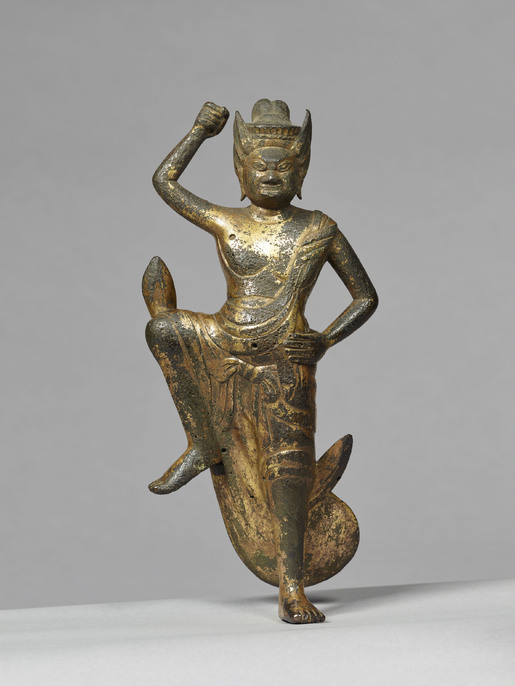
The face was expressed with anger and rage, the left foot stomped on the rock and the right leg was kicked up aloft. Because statues of Zaō gongen were often enshrined in the temples in mountains, most of the works were made from metal to survive in severe environments. The material was applied not only bronze, but also iron. {br=>[[]], content=>[Zaō-gongen, who is one of the original Japanese Buddhist deities in Japan, is said to have appeared in front of Enno-gyōja, when he was training himself on Mt. Kimpusen in Yoshino. Enno-gyōja was a master of mountain incantation, and he is said to have established Shugendō Buddhism. The character of Zaō-gongen was defined during or after the Heian period, when Shugendō Buddhism was already fully developed. The furious eyes, raised right fist, and the lifted right leg of Zaō-gongen indicate the influence from the images of esoteric Buddhism. The two-dimensional images of Zaō-gongen were often depicted on the backside of bronze mirrors, on hanging amulets, and the three-dimensional images were made as wooden and bronze statues., The statue discussed here was cast in bronze. A thick coating of gold is still extant over the chest part and the backside of the statue. During the Kamakura period, the body of Zaō-gongen was often depicted as leaning toward one direction to emphasize its anger, but this statue stands relatively upright, and a kind of calmness can be observed even in the rigid face. Such a gentle expression must be a work of the late Heian period. This statue is a very important example of a Zaō-gongen figure.]} {i=>[jōhaku, kun, kun, vajra, yōraku], br=>[[]], content=>[This statue depicts Zaō Gongen, a Sh into-Buddhist combinatory deity central to the mountain ascetic practice known as Shugendō. The figure’s left hand is placed on the waist, and the raised right hand grasps an object (now lost).
The entire body is supported by the left leg, while the right is raised up. This pose imbues the statue with a sense of power and tension. The deity faces forward with a straight upper body, as if correcting its posture, and the left leg stands perpendicular to the ground in a powerful rendering reminiscent of early Zaō Gongen statues. Traits from the late Heian period (12th century) are seen in the balanced head and body, the full chest, and the slender arms and legs. The statue also has a stern look, with large facial features, up-angled eyes, and upper teeth biting down on the bottom lip. These elements emulate earlier styles of Zaō Gongen statues. Although it wears Zaō Gongen’s typical attire—a band of cloth draped crosswise over the shoulder (, ), a waistcloth, and a wraparound skirt (, )—it lacks the animal skin the figure is often depicted wearing. The bottom hem of the , is wrapped around both legs and is pulled upward from both kneecaps similar to a dhoti, reflecting a style likely based on earlier designs. , The statue was produced using lost-wax casting, and holes presumably formed by a mid-sized support structure penetrate the statue’s interior at the back of the bound hair and the back of the right leg. The bronze walls are thin, and a place on the back of the skirt where molten metal once filled a hole made by a metal wedge that held the outer and inner molds in place has been removed and left open. Despite its pitted appearance, the surface was gilt. The figure’s jeweled crown, which might have been a three-pronged , crown, has been lost. Holes for attaching ornamental chains (, ) remain on the front of the body. The statue is an exceptional work produced in the late Heian period (794–1185) that faithfully preserves elements of earlier styles.]}
— Museum description: Nara National Museum (CC BY 4.0), via ColBase / Japan Search.