National Treasure

Blade for a Dagger (Tantō)
短刀
Swords & Armour · Nanbokuchō, 14th centuryTNM
Home › Browse › Swords & Armour › Nanbokuchō period › Blade for a Dagger (Tantō), Named “Hitotsuyanagi Yasuyoshi”
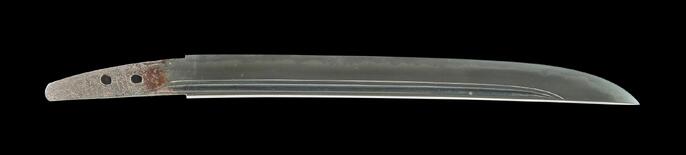
With a blade 30 cm long, this sword is large for a tanto. The blade’s tang is short, and the bladed portion is wide. The showy, impactful form of this tanto was popular in the mid-14th century. Its maker, Sa no Yasuyoshi, is said to be the son of the swordsmith Samonji, of Fukuoka Prefecture, who inscribed his blades with the character “左” (sa). A fine pattern resembling wood grain can be seen on the dark side of the blade, with a shadowy white cloud over it. There is also a gleaming pattern, called a hamon, near the edge of the blade, along the border between its light and dark portions. This hamon is generally restrained, without sharp dips or rises, but when brandished it reflects light more than other swords, creating a sharp impression.
This tanto is named the Hitotsuyanagi Yasuyoshi because it belonged to the late 16th to early 17th-century samurai warlord Hitotsuyanagi Naomori. It is a typical example of Sa no Yasuyoshi’s style. With a cutting edge over 30 centimeters (12 inches) in length, this blade is unusually large for a Japanese dagger. Oversized daggers and swords were commissioned as sacred offerings to the gods, or as personal weapons for important samurai. This example was owned by the samurai warlord Hitotsuyanagi Naomori (1564–1636).
— Museum description: Tokyo National Museum (CC BY 4.0), via ColBase / Japan Search.





