National Treasure

Blade for a Dagger (Tantō)
短刀
Swords & Armour · Nanbokuchō, 14th centuryTNM
Home › Browse › Swords & Armour › Nanbokuchō period › Blade for a Long Sword ("Katana"), Named "Ishida Masamune"
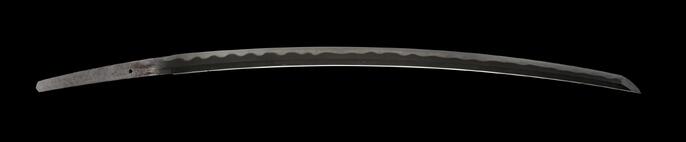
The beauty of the sword lies in its well-balanced curve. A gleaming pattern, called a hamon, separates the light and dark portions of the blade. The hamon of this piece forms a gently curved line punctuated by sporadic, semicircular humps. On closer inspection, crystalline particles called nie are visible in the hamon, resembling a scattering of silver dust and lending it an abundance of subtle variation. The scratches, called kirikomi, on the mune, the back of the blade, opposite the cutting edge, were inflicted in clashes with enemies. This sword’s maker, Masamune, was a swordsmith active in Kamakura, Kanagawa Prefecture during the 14th century.
The beauty created by the variations in nie is one of Masamune’s trademarks. This sword is named the Ishida Masamune because it belonged to the 16th-century samurai warlord Ishida Mitsunari. In the 1300s, the master swordsmith Masamune succeeded in creating blades of unprecedented lightness and strength. This example once belonged to the warlord Ishida Mitsunari (1559–1600), a pivotal figure in Japanese history. He is remembered for leading the Western Army at the decisive Battle of Sekigahara in 1600.
— Museum description: Tokyo National Museum (CC BY 4.0), via ColBase / Japan Search.





