National Treasure
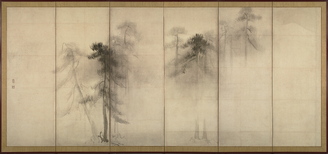
Pine Forest
松林図屏風
Paintings · Muromachi, 16th centuryTNM
Home › Browse › Paintings › Muromachi period › Horse Stable
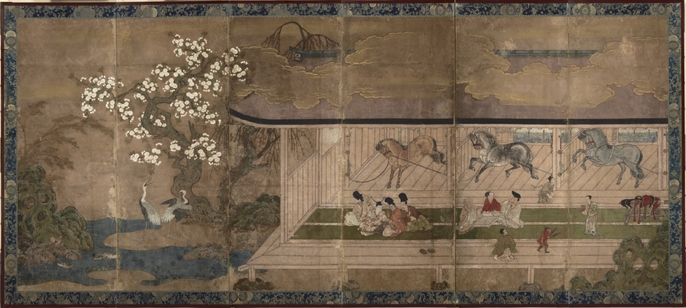
A painting of a stable with 6 horses ranges across a left-and-right pair of folding screens. The three horses tied up on the right are resting peacefully, but the three on the left are kicking up their legs and creating an altogether more rambunctious scene. Beautiful, strong steeds like these commonly featured in paintings as symbols of power and authority. We don't know who commissioned this work or what meaning they were trying to convey. Perhaps these are military horses and the person who commissioned this painting was captivated by their beautiful appearance, or maybe they are sacred horses and hence were painted with some prayer in mind. If you look closely, you will see various people gathered at the stable. They seem to be enjoying some board games. The figures on the right screen are playing go, while those on the left screen are playing shogi and sugoroku, all traditional Japanese board games. Other figures can be seen lying on the floor, carrying tea or looking at the horses. The relationship between these people remains a mystery, as does the overall theme of the painting.
Two other animals also make an appearance – 2 dogs on the right screen and a monkey on the left. Monkeys were regarded as tutelary deities for stables and were often depicted together with horses. As for the dog, if these are indeed military horses, then perhaps it was brought along with the horses on falconry expeditions. Another intriguing feature is the scenery outside the stable, depicted on the edges of both screens. On the right we see pine trees with wisteria, three egrets and a turtle. On the left, meanwhile, are cherry blossoms with willows, cranes and mandarin ducks. Each scene is packed with auspicious motifs. Six leashed horses stand in a stable while people enjoy board games nearby. The surrounding scenery includes auspicious plants and animals such as pines, cherry trees, cranes, and turtles. Horses were symbols of wealth, and folding screens featuring horses were popular especially during the Muromachi period (1392–1573).
— Museum description: Tokyo National Museum (CC BY 4.0), via ColBase / Japan Search.