National Treasure

Engishiki (Rules and regulations concerning ceremonies and other events)
延喜式
Calligraphy & Books · Heian, 901–1400TNM
Home › Browse › Calligraphy & Books › Heian period › Kokin Wakashu Poetry Anthology, Gen'ei Version

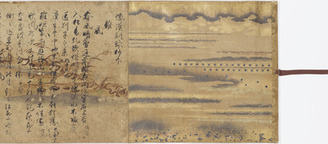
The Collection of Japanese Poems Ancient and Modern was compiled during the Heian period. It is the earliest example of Japanese poetry anthologies commissioned by emperors. Only transcripts of the original have survived to the present day. This extremely valuable work is the oldest extant copy and it was passed down in more-or-less its original form. It comprises two books bound together with string. It is named the “Gen'ei era version” after an inscription at the end of the first book, which dates the work to the 24th day of the 7th month of Gen'ei 3, or 1120 in the Western calendar. The Gen'ei-era version is characterized by its resplendent paper.
Each double-page spread alternates between paper with printed patterns and paper decorated with small pieces of cut gold and silver foil. The patterns are also richly varied, while the writing style and positioning changes artfully over each double-page spread. The writer is thought to be Fujiwara no Sadazane, great-grandson of the renowned calligrapher Fujiwara no Kozei. The Japanese kana script was established at the start of the Heian period. As kana calligraphy became more refined and beautiful during the late Heian period, writing paper also becoming more lavish, as this epitome of Japan's elegant court culture shows.
— Museum description: Tokyo National Museum (CC BY 4.0), via ColBase / Japan Search.