National Treasure

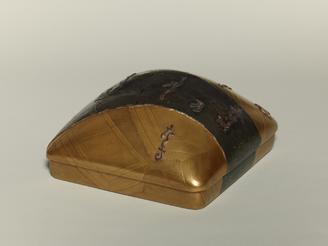
Box for Personal Items with a Design of Carriage Wheels in Water
片輪車蒔絵螺鈿手箱
Lacquerware · Heian, 12th centuryTNM
Home › Browse › Lacquerware › Heian period › Saddle with Bush Clovers

Japanese saddles consist of three parts: the contoured panels the rider sits on, the front arch, or pommel, and the hind arch, or cantle. This saddle features an exquisite design of bush clovers. The clovers are depicted in an unconstrained fashion that utilizes the gentle curves of the front and rear arches. Flattened pieces of mother-of-pearl have been cut into different shapes and inlaid into the surface, with black lacquer brushed on top and the surface then polished to reveal the design. This technique is known as “raden” and it is commonly used in Japanese lacquerware to produce designs that shine like pearls.
The graceful, elegant sensibilities of the Heian period are on full display in saddles like this. Japanese saddles are made of lacquered wood, with padding added for comfort. This rare 12th-century example was likely made for an elite samurai to use in ceremonies. Hundreds of pieces of cut seashell adorn the surface. They are meticulously arranged to depict bush clovers, which are celebrated in Japan as one of the Seven Autumn Grasses.
— Museum description: Tokyo National Museum (CC BY 4.0), via ColBase / Japan Search.