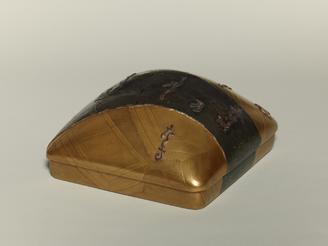
National Treasure

Box for Personal Items with a Design of Carriage Wheels in Water
片輪車蒔絵螺鈿手箱
Lacquerware · Heian, 12th centuryTNM
Home › Browse › Lacquerware › Kamakura period › Saddle with Lions

A ground of gold powder contrasts with lions in mother-of-pearl. These materials were popular around the 12th and 13th centuries for saddle trees used by the samurai. Japanese saddles consist of three parts: contoured panels on which the rider sits, a pommel in front, and a cantle behind. Made of wood and having a thick, solid cantle and a wide seat, this saddle is an example of early Japanese saddle design. Its surface is coated in black lacquer, and the outer surfaces of its pommel and cantle are decorated with mother-of-pearl inlay depicting three lions in a variety of poses against a background densely sprinkled with gold dust. To make mother-of-pearl inlay, flat pieces of mother-of-pearl are cut from the interiors of mollusk shells and arranged to form designs.
These designs, which have a rainbow sheen like pearls, are widely used in Japanese lacquerware. The use of sprinkled gold powder is another traditional Japanese lacquerware technique. In this piece, gold dust has been sprinkled so thickly that it obscures the lacquered surface beneath, lending a golden glow to the entire surface. Many pieces of lacquerware featuring mother-of-pearl designs against a background of densely sprinkled gold powder were produced from the late-Heian period into the Kamakura period (from the 12th to the 14th century). This saddle is a precious example from the beginning of that period. The lions are skillfully differentiated by their expressive faces and stand out impressively against the gold background.
— Museum description: Tokyo National Museum (CC BY 4.0), via ColBase / Japan Search.