National Treasure
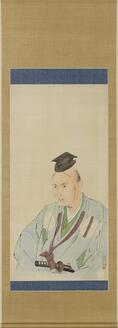
The Scholar Takami Senseki
鷹見泉石像
Paintings · Edo, 1837TNM
Home › Browse › Paintings › Meiji and later period › Scene from the Noh Play Yoroboshi
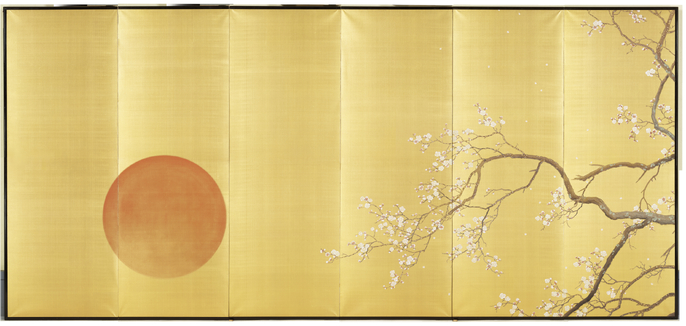
In a garden with blooming plum trees at Shitennoji Temple, a blind youth, disowned by his father, begs and offers a prayer facing the setting sun. A huge plum tree with pretty white blossoms unfurls across the right screen and spills over into the left screen. A hunched man with a cane stoops down amid the falling blossoms with hands clasped together. He has long frayed hair and closed downcast eyes. He is offering a prayer toward the setting sun as night approaches. Perhaps he feels a sense of profound sadness in this dramatic scene. Or perhaps he is filled with strong emotion as he expresses his single-minded devotion. This work is based on Yoroboshi, a play from the Noh theater, a traditional Japanese performing art. The word yoroboshi means a weak, feeble mendicant priest. The play is set in the second month, when plum blossoms are in full bloom. Filled with remorse at disowning his own son, Saemon-no-jo Michitoshi has come to give alms to the poor at Shitennoji Temple in Osaka. While there, a blind youth nicknamed Yoroboshi totters on a cane toward Michitoshi.
As night approaches, the boy has come to pray to the setting sun as a representation of Amida Nyorai, or Amitabha in Sanskrit. Upon seeing this, Michitoshi realizes the youth is none other than his own son, so he takes the boy‘s hand and together they return home. As Japan made steps towards becoming a modern state at the end of the 19th century, there was a surge in the popularity of paintings that incorporated Western painting styles. However, many artists continued to paint in the traditional style by using ink and pigments on paper and silk to create paintings on hanging scrolls, handscrolls and folding screens. Nonetheless, they still tried to follow the times by searching for forms of expression suitable for the new era. The painter Shimomura Kanzan was born in Wakayama Prefecture in 1873 and he died in 1930. While inheriting the compositions and techniques of traditional Japanese painting, he strove to pioneer new forms of expression. In doing so, he left behind many masterpieces, like this work.
— Museum description: Tokyo National Museum (CC BY 4.0), via ColBase / Japan Search.