National Treasure

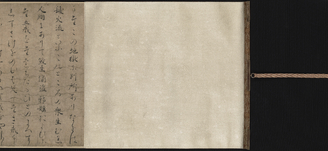
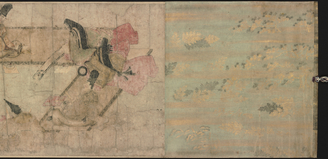
Bound Fan Papers with the Lotus Sutra
扇面法華経冊子
Paintings · Heian, 12th centuryTNM
Home › Browse › Paintings › Heian period › The Bodhisattva Kokūzō

This is a painting of Kokuzo Bosatsu, or Akasagarbha in Sanskrit. The Japanese word 'kokuzo' translates as 'vast space' and the name refers to the deity's boundless virtue and wisdom. The worship of Kokuzo Bosatsu began in Japan during the 8th century and it became widespread thereafter. This was mainly because practitioners believed they could gain infinite powers of memory by undergoing training with Kokuzo Bosatsu as the principal image. This trend is evidenced by the large number of extant Japanese statues and paintings depicting the deity. This work is known to be the oldest extant such painting and also the most accomplished. The bodhisattva sits on a lotus flower above a rock. His left arm is held up before the chest and he holds a sacred Buddhist gem known as a hoju in the palm of his left hand.
This is how we know this is a depiction of Kokuzo Bosatsu. His body is surrounded by a round light that resembles an aura. A closer look reveals various patterns on the garments. These are drawn using extremely fine gold lines rendered using a technique called kirikane, whereby finely-cut pieces of gold leaf are pasted onto the surface to form a pattern. The level of detail is astounding, as further epitomized by the reddish-white skin and the subtle tonal gradations, for example. This meticulous expression is characteristic of paintings from the 12th century, when Japanese Buddhist painting reached its apex. The work also featured an abundance of silver. Though this has since blackened, it was probably used to create an atmosphere of peaceful serenity.
— Museum description: Tokyo National Museum (CC BY 4.0), via ColBase / Japan Search.