Important Cultural Property
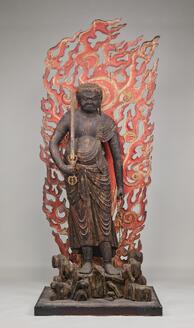
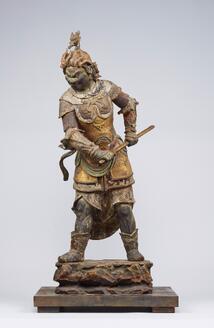
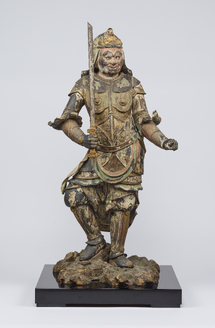
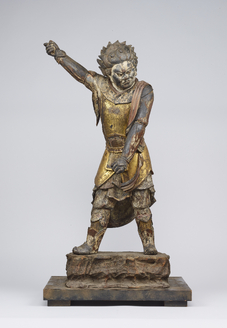
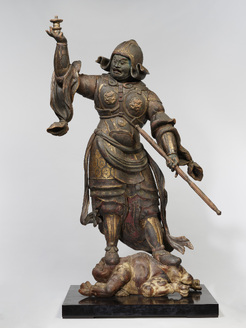
The Wisdom King Fudō
不動明王立像
Sculpture · Heian, 11th centuryTNM
Home › Browse › Sculpture › Heian period › The Buddha Dainichi
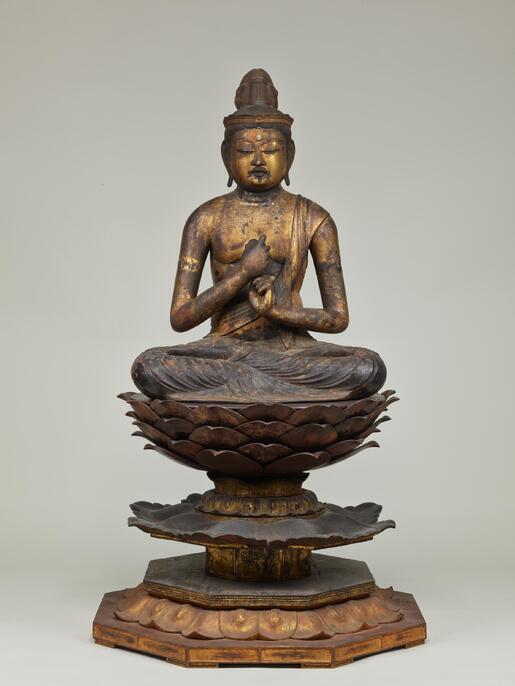
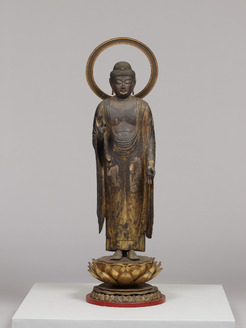
The Buddhist pantheon features numerous deities, each with their own name, form, and role. Buddhas are beings who have understood the ultimate truth and attained enlightenment. Deities who are training to become buddhas are known as bodhisattvas. The central deity in Esoteric Buddhism is the Buddha Dainichi. He is said to be the source of all creation. In the 9th century, a Japanese priest named Kukai travelled to China to study Esoteric Buddhism. On his return to Japan, he began propagating this new belief. Dainichi subsequently became the subject of fervent devotion, with many sculptures and paintings of the deity produced thereafter. Buddhas are usually depicted wrapped in simple, thin robes with bowl-shaped heads and hair that appears tightly permed. Only Dainichi is portrayed with a high topknot, a crown, and ornamentation around the chest and arms. This type of depiction is usually reserved for bodhisattvas. This is a wooden statue of Dainichi. The body parts were sculpted separately and then fitted together, with gold leaf then attached to the surface and color applied to the face and hair.
Both elbows are bent at the waist, with the extended index finger of the left hand wrapped in the clasped right hand. This unique pose and the bodhisattva garments are what reveals this to be a depiction of Dainichi Nyorai. He is portrayed with a gentle countenance and a thin body with little undulation. These characteristics were common to Japanese statues produced from the 11th to the 12th century. Most of the deity's lotus-shaped pedestal is also thought to have been created at the same time as the main statue. According to [mikkyō], the “secret” teachings of Buddhism, Dainichi is the creator of the universe and the king of all buddhas. He grips his left forefinger with his right hand, a gesture expressing the spiritual union of buddhas and people. His slender body and flowing robes reflect the aesthetic tastes of the court nobility, the primary patrons of Buddhism when this sculpture was created.
— Museum description: Tokyo National Museum (CC BY 4.0), via ColBase / Japan Search.