Important Cultural Property
Bodhisattva
菩薩立像
Sculpture · Kamakura, 13th centuryTNM
Home › Browse › Sculpture › Kamakura period › The Monkey General, One of the Twelve Divine Generals

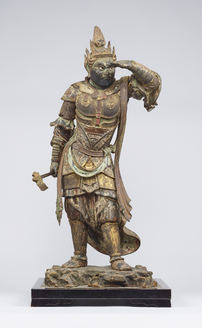
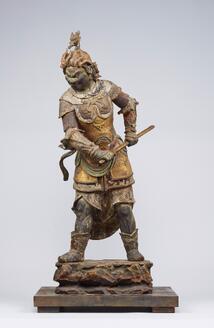
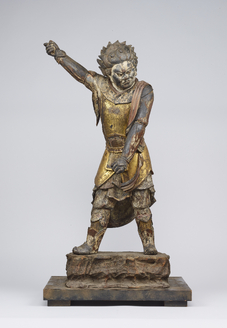
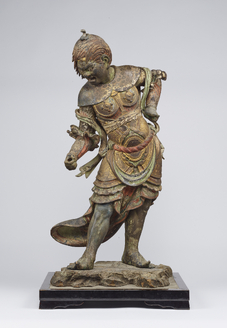
The Twelve Heavenly Generals are a group of deities charged with protecting Yakushi, a Buddha associated with healing. This statue depicts Shinshin, the Monkey General. This statue was carved from the wood of a cypress tree, with color then applied to the entire surface. He wears armor and he carries a sword in his right hand. His right leg is bent and he stands with right foot forward. This is a fitting posture for a military commander displaying his power. However, there is also something humorous about his facial expression, with eyes open wide beneath mountain-shaped eyebrows and a mouth that seems to be smiling. A monkey's face is carved onto the top of his head, but the general himself also seems like a monkey with his humorous expressions and red face. The body movements convey a sense of spatial depth. This, together with the realistic expressions and the sharp, refined shape, are characteristic features of statuary that emerged from the end of the 12th century, as epitomized by the works carved by Unkei, a famous Japanese sculptor. This statue seems to herald the start of a new era. The still-vivid colors provide a further highlight alongside the dynamic motion. This work was originally from a set of 12 Heavenly Generals.
The other 11 statues are also still with us today. Like this example, they also wear depictions of creatures from the Chinese Zodiac on their heads. Tokyo National Museum is home to five of these statues. The number of generals corresponds to the 12 vows made by Yakushi Nyorai to save all sentient beings. Furthermore, it was customary in East Asia since ancient times to divide time or directions up into 12 units and then allocate a different animal to each one. The Chinese Zodiac is still familiar to many people today. The signs of the Chinese Zodiac were also assigned to the guardians of the Buddha Yakushi. In a sense, this symbolizes how the 12 generals continue to keep a close watch over all directions at all times. This figure was worshiped for approximately 600 years at Jōruriji, a historic Buddhist temple located south of Kyoto. It represents one of the Twelve Divine Generals, guardian gods who serve and protect Yakushi, the Buddha of Healing. Each general is associated with an animal of the Chinese zodiac. This one has a small monkey atop his head, and his facial features echo the playful spirit of this creature.
— Museum description: Tokyo National Museum (CC BY 4.0), via ColBase / Japan Search.