Important Cultural Property
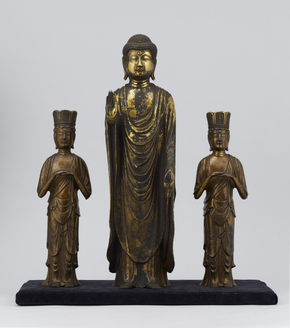
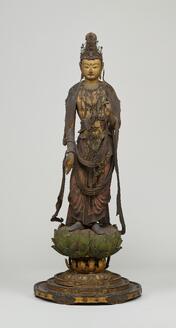
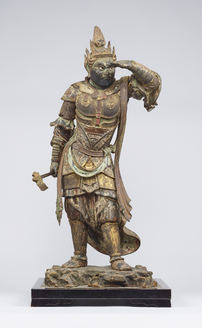
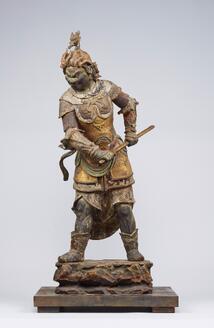
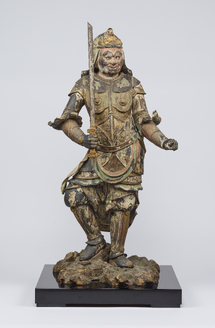
The Buddha Amida with Two Attendants Depicted in the Zenkōji Style
阿弥陀如来および両脇侍立像(善光寺式)
Sculpture · Kamakura, 1254TNM
Home › Browse › Sculpture › Kamakura period › The Buddha Amida
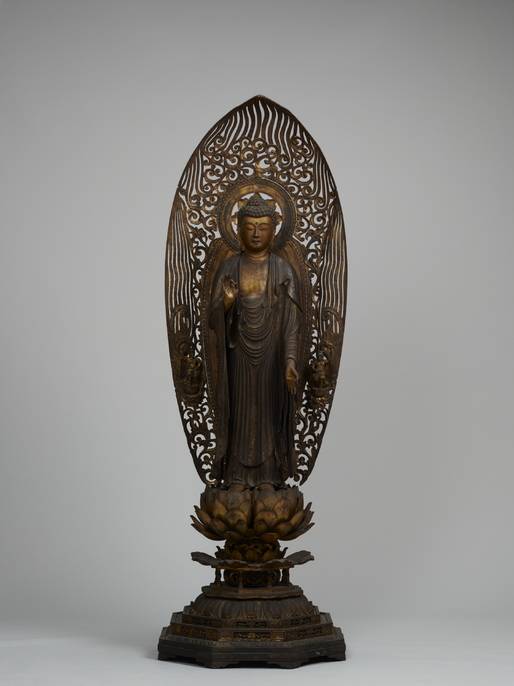
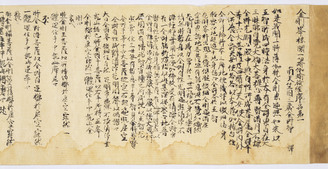
The signs formed by the hands and fingers of Buddhist statues are known as ‘in.’ They symbolize the blessings and workings of Buddha. This is a statue of Amida Nyorai, or Amitabha in Sanskrit. It forms two circles with its thumbs and index fingers. The right hand is raised and the left hand is held lower. This sign symbolizes the descent of Amitabha to welcome the dead into the Pure Land. It has been revealed that an inscription is written in ink inside the back of the head. It recounts in detail how the statue came to be made. According to the inscription, it was carved in 1259 by a 21-year-old sculptor named Eisen, who used timber from the town of Issaikyodani in Higashiyama, Kyoto. The statue was commissioned by a priest named Shinkan as a good deed and as a memorial for his close relative. In ancient times in China and Japan, inscriptions were usually etched in places where people could see them, such as on the pedestal or halo. During the Heian period, which began in the late 8th century and lasted until the late 12th century, however, wooden sculptures grew in popularity and it became more common to carve inscriptions inside the statues or in other places not easily seen.
Perhaps people believed the inside of a Buddhist statue was a holy place, with a prayer more likely to come true when inscribed there in secret. Or perhaps they believed that if they placed part of their soul inside a Buddhist statue in the form of an earnest entreaty, this would imbue the statue will a sacred life of its own. If we try to put ourselves in the shoes of the people who made these statues, it gives us a whole new way of looking at them. Incidentally, the intricate designs of the garments are one of the highlights of this work. It uses a technique in which thin, hair-like strips of gold foil are adhered to the surface to create the pattern. This figure’s hand gesture identifies him as the Buddhist god Amida, descending to earth to lead the faithful to paradise. The head is hollow and contains a hidden inscription. It states that a Buddhist monk named Shinkan commissioned the figure in 1239, hoping Amida would save the soul of a recently departed relative.
— Museum description: Tokyo National Museum (CC BY 4.0), via ColBase / Japan Search.