National Treasure

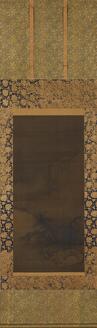
Snowy Landscape
雪景山水図軸
Paintings · Kamakura, 13th centuryTNM
Home › Browse › Paintings › Kamakura period › The Zen Monk Dongshan Crossing a Stream

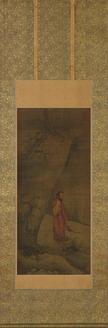
The monk Dongshan experienced enlightenment upoin seeing his shadow reflected while crossing a river on a pilgrimage. The artist's placement of the scene in the lower part of the frame is unconventional. Dongshan was a 9th-century Buddhist monk who established the Caodong School, one of the five schools of Chan Buddhism, the origin of Japanese Zen Buddhism. It is said that Dongshan reached enlightenment when he was crossing the river and saw his own reflection in the water during a pilgrimage. This painting captures that moment. The upper section of the painting was inscribed by an empress of the Southern Song Dynasty in the 13th century. Dongshan lifts the hem of his robe with his left hand and holds his staff with the right. He looks at the surface of the water with a faint smile on his face. His face is depicted in soft black lines to convey the texture of his skin, and fine shading has been placed around his eyes and nose. His eyes are narrow, and the lines of the upper eyelids are drawn thicker to show an expression that is both refined and benevolent, showing his strong determination.
The background is simple, with a lot of blank space. At Dongshan's feet are gentle lines of waves. The left side of the riverbank is covered with grass, and on the upper right, shadows of far-off mountains are depicted in indigo blue. There is no artist seal on the painting, but with this particular style of delicate portraiture, and suggestive depiction of the landscape, it is thought this work was made by the court painter Ma Yuan, or by a member of his studio, during the Southern Song Dynasty. Ma was born into a family that produced Buddhist paintings for a living. He was particularly skilled at making viewers feel the depth of his landscapes by carefully selecting motifs and painting them in the background of his compositions. This piece was painted as part of a set, alongside two other paintings: one depicting Yunmen Wenyan, the founder of the Yunmen school of Buddhism, and one depicting Qingliang Wenyi, founder of the Fayan school. Both works are currently in the collection of Tenryu-ji Temple in Kyoto.
— Museum description: Tokyo National Museum (CC BY 4.0), via ColBase / Japan Search.