National Treasure
Amusements under the Blossoms
花下遊楽図屏風
Paintings · Edo, 17th centuryTNM
Home › Browse › Paintings › Edo period › Traveling through Autumn Mountains
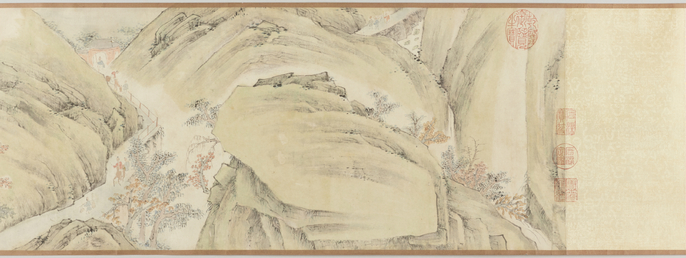
Xiao Yuncong was a painter from the Anhui region in southern China who lived during the 17th century, amidst the transition from the Ming (1368–1644) to the Qing dynasty (1644–1911). He aspired to become a high government official and sat for the civil service examinations numerous times. In the end, however, the Ming dynasty fell before he succeeded in passing them. It is said that Yuncong was forced to flee his home during the chaos amidst dynastic change. He made no attempt to serve the Qing dynasty, which was ruled by the Manchus, people of a different ethnicity than himself, and pursued a career as a private scholar and painter. At that time, the Anhui region was known for producing high-quality woodblock prints. Yuncong was famous for painting originals that became the basis for such prints. This large, illustrated handscroll, “Traveling through Autumn Mountains,” is a valuable example of a painting in Yuncong’s own hand. It is possible to pick up on Yuncong’s delicate brushwork and sense of color, which are not visible in prints. The first half of the handscroll depicts travelers journeying through an unbroken succession of mountains. The red color of the foliage suggests that the season is autumn. The latter half of the handscroll depicts a river landscape with a large amount of blank space.
Temples and pagodas that suggest real scenery are also visible in both scenes. The whole composition is colored in warm, pale hues. The people, horses, cattle, boats, and other animals and vehicles appear to be painted in a deliberately crude style. There is an indefinable tranquility and charm to them. The mountains, roads, water, and sky are connected in a way that ignores a rational sense of depth and makes the viewer feel as if they are drifting through a dream. At the end of the handscroll, there is a colophon that Yuncong wrote when he was 62 years old. He writes that this painting went missing after he painted it several decades earlier, and that it possesses a force and subtlety that he can no longer match in his old age. “Traveling through Autumn Mountains” later became part of the collection of the 6th Qing emperor, Qianlong. You can see the emperor’s poetry and seal of ownership in many places throughout the painting. This handscroll retains the box, wrapping cloth, tie, jade fastener, and other accessories that were added to it in the Qing imperial court. This is another feature that contributes to its value.
— Museum description: Tokyo National Museum (CC BY 4.0), via ColBase / Japan Search.