National Treasure

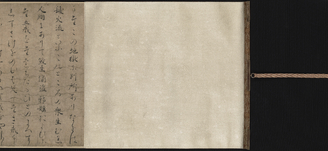
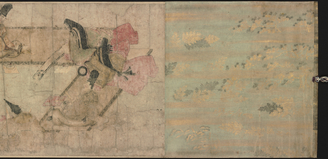
Bound Fan Papers with the Lotus Sutra
扇面法華経冊子
Paintings · Heian, 12th centuryTNM
Home › Browse › Paintings › Heian period › Bamboo Grove and Wild Geese

A pack of wild geese gather near a shore filled with dry reed. They are captured in all sorts of poses: One sticks out its neck and looks around, one pecks at food, another arranges its wings, and one sleeps with its head tucked in its wing. From the patterns of their feathers to the subtle coloring of their beaks, the whole scene is meticulously depicted. Above them, hand-shaped bamboo leaves spread thickly and tree branches reach upward, crossing together in complex patterns. The tips of the branches are shown in a light green, with visible dark red spots. This tree may be a plum that blooms in early spring. In the upper right-hand corner of the painting, a pair of birds called daurian redstarts can be seen resting on the branches. The male can be recognized by his blue head and bright orange belly, while the female is pale brown in color. Behind the birds and the plants, the shore on the opposite side of the water is drawn in a simple way without color. Well aware of diagonals, the artist has depicted the motif of geese in the right bottom, while hinting at space in the distant mist in the upper left.
In Chinese art history, the transitional period between the 10th and the 11th century is referred to as the golden age of landscape painting. New techniques to suggest three-dimensional space started being used in this period. Even bird-and-flower paintings, which typically showed close-ups of birds and plants without a background, started depicting subjects in the background with depth, where they would blend in naturally with the main motif. This kind of painting, which involved elements of both landscape painting and bird-and-flower painting, was referred to at the time as small landscape painting. This famous painting of the Song-dynasty (960–1279) is one such work. Within a small frame, the artist has carefully depicted various bird-and-flower motifs, while also managing to depict the nature in the background in a naturalistic way. A pack of wild geese quietly gather near a shore filled with dry reeds. This kind of painting, which involved elements of both landscape and bird-and-flower paintings from the Song Dynasty (960–1276), is known as a “small landscape painting.”
— Museum description: Tokyo National Museum (CC BY 4.0), via ColBase / Japan Search.