National Treasure
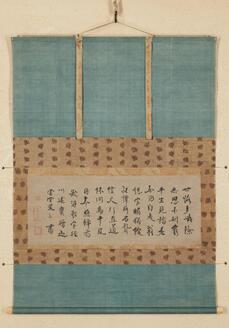
Buddhist Verse (Called “The Torn Xutang”)
照禅者宛偈頌(破れ虚堂)
Calligraphy & Books · Kamakura, 13th centuryTNM
Home › Browse › Calligraphy & Books › Kamakura period › Letter
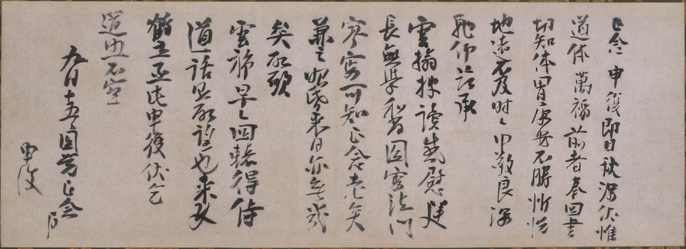
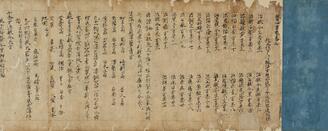
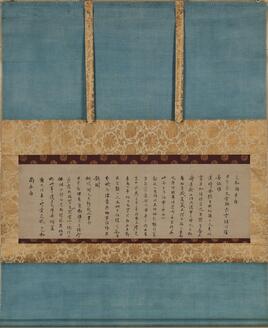
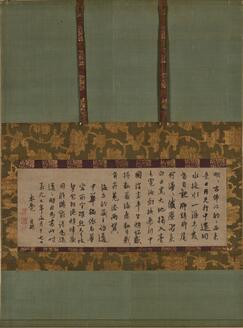
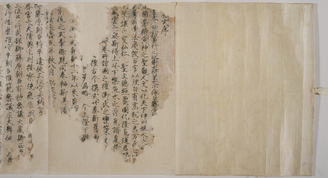
This letter was written by Daikyū Shōnen (1215–1289), a Zen Buddhist monk. Daikyū was born in Wenzhou in Zhejiang Province, China. He came to Japan at the invitation of Hōjō Tokimune, the regent of the Kamakura shogunate who controlled all government functions. Daikyū became the head monk of temples including Kenchōji and Engakuji, and died in Japan. The contents of the letter tell us that Daikyū wrote it at the age of 72, after the death of Wuxue Zuyuan in 1286. Wuxue was a Zen monk from China who founded Engakuji Temple. The letter does not contain an addressee’s name, but it expresses Daikyū’s condolences to the late Wuxue’s disciples. The letter is written vertically from right to left. The first five lines are written courteously and neatly. Beginning on the sixth line, however, the feel of the characters seems to have changed. The brushwork grows less stiff, the characters become somewhat larger, and the script is more forceful than in the opening lines.
This is the section that concerns the late Wuxue. This change in Daikyū’s writing style is probably a reflection of his sadness that welled up in his heart. In a handwritten letter, the writer’s emotions naturally reveal themselves through his brush. By looking at a letter from beginning to end as if to trace the time at which each section was written, we can clearly see the changes in the writer’s emotions. Calligraphy can provide subtle insights into the writer’s emotions. This letter, read from right to left and top to bottom, was written by the Zen master Daxiu Zhengnian (1215–89) about a recently deceased fellow monk. The first five lines are neat and formal, but from the sixth line — the part about his departed colleague — the characters become larger, freer, and more forceful, perhaps reflecting Daikyū’s deep sorrow.
— Museum description: Tokyo National Museum (CC BY 4.0), via ColBase / Japan Search.