Important Cultural Property
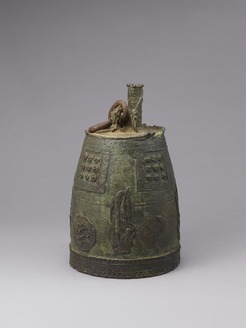
Bronze bell
銅鐘
Metalwork · Kamakura, 1201Kyushu NM
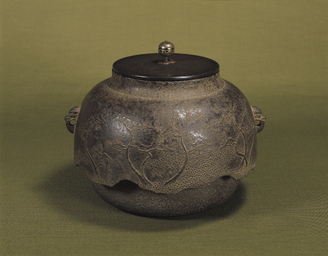
Home › Browse › Metalwork › Muromachi period › Shinnari-type iron tea kettle depicting maple leaves, a stream, and chickens

This large tea kettle has a tall kettle mouth and two lion head shaped loops casted on its shoulder. It is commonly known as Tatsutagawa (Tatsuta River), since the designs of the two lively birds together with the maple leaves floating on the stream remind the viewers of a poem in the Hundred Poems by One Hundred Poets. “Even in the ancient days when gods and goddesses reigned, I have never heard that water gleamed with autumn red, as it does in Tatsuta’s stream.” Such Ashiya-gama tea kettles were made during the 15th century Muromachi period (1338–1572) in Ashiyatsu in Chikuzen province (present-day Ashiya, Onga, Fukuoka) under the patronage of the Ōuchi family, the Suō province feudal lord (present-day Yamaguchi). These tea kettles were treasured by court nobles, warriors, and Buddhist priests in Kyoto for their rounded shape (shinnari-type), the rigid expressions of the loops, deep-colored sleek catfish-like skin (namazu-hada), and thin walls designed to enhance the ease of use. Many literary works attested to the popularity of Ashiya-gama kettles.
The Sekiso Ōrai, a book written in the mid-Muromachi period, for instance, stated that Ashiya-gama was a synonym for a tea kettle. There is also a letter from Mansai, a priest of Sanpō-in sub-temple of Daigo-ji temple in Kyoto, to Munakata Ujitsune, the chief priest of Munakata Shrine (dated 21st September, 14th year of the Oei era (1407) in the lunar calendar, Munakata shrine collection), Mansai reminded Munakata to deliver a kettle that he had ordered since it had not reached the temple by the due date. Considering the proximity of the Munakata shrine to Ashiya, the tea kettle that Mansai was waiting for was probably a Ashiya-gama tea kettle. In later years, this tea kettle had its bottom replaced, which explains why it is odare (eaves) shaped. The namazu-hada, which is the main feature of Ashiya-gama tea kettles, remains only partially. However, this tea kettle still retains many other attractive features that had once fascinated the Kyoto residents.
— Museum description: Kyushu National Museum (CC BY 4.0), via ColBase / Japan Search.