National Treasure
Bound Fan Papers with the Lotus Sutra
扇面法華経冊子
Paintings · Heian, 12th centuryTNM
Home › Browse › Paintings › Heian period › The Sixteen Arhats
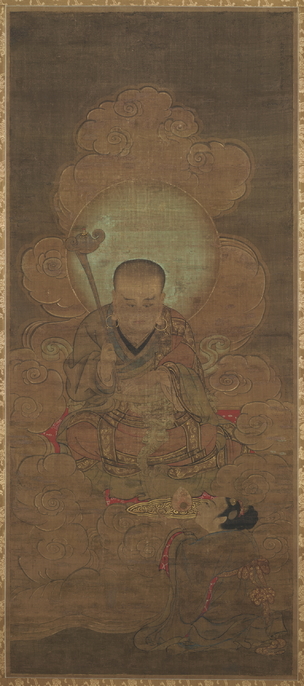
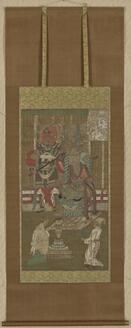
An arhat is a priest who has completed his Buddhist training and succeeded in completely freeing himself from worldly desires. A sutra called The Record of the Duration of the Law was translated in Tang-dynasty (618–907) China during the 7th century. According to this text, when Shaka, the founder of Buddhism, was on his deathbed, he entrusted sixteen arhats with remaining in the world and preserving Buddhist teachings. These picture scrolls of the arhats, of which the Tokyo National Museum currently has sixteen in its collection, each depict one of those sixteen arhats. There were originally 16 scrolls, but the whereabouts of five are unknown, and the remaining one is in the collection of The Museum of Modern Art, Gunma. Each picture scroll bears the inscription, “Painted by Jin Dashou of Ningbo during the Song Dynasty.” Ningbo, a city on the coast of Zhejiang Province, was a center of maritime trade between Japan and China in ancient times.
It also witnessed a flowering of Buddhist culture. Many pieces of Buddhist art produced in Ningbo were brought to Japan. The name Jin Dashou appears in the Kundaikan-sōchōki, a Japanese catalogue listing Chinese artworks and objects written in the 16th century, showing that he has been highly regarded in Japan since that time. The arhats are depicted with a variety of facial features. Some are young and clean-cut, others have large, foreign-looking mouths and eyes, and still others are elderly and bizarre-looking. Each scroll entertains the viewer with a wealth of variation in their backgrounds, including natural landscapes, furniture, tools, attendants at the arhats’ sides, and sacred beasts such as dragons, phoenixes, and tigers. These paintings were highly influential on images of the arhats created in Japan. They are notable for their extravagant-yet-refined color palette, which makes heavy use of gold and neutral tones.
— Museum description: Tokyo National Museum (CC BY 4.0), via ColBase / Japan Search.