National Treasure
Tale of Flowering Fortunes
栄花物語
Calligraphy & Books · Kamakura, 1201–1300Kyushu NM
Home › Browse › Calligraphy & Books › Kamakura period › Calligraphy by Kohō Kakumyō: Zen teachings for Hoju Daishi
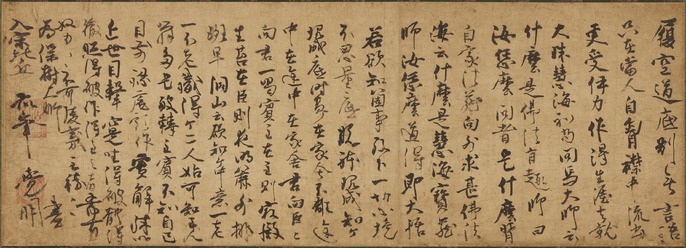
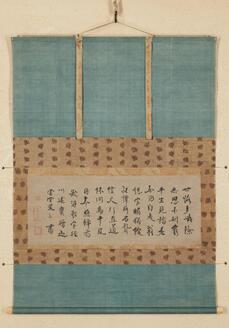
Kohō Kakumyō (1271–1361) was a Japanese Zen priest active from the Kamakura period (1192–1333) to the Nambokucho period (1336–92). He began his Buddhist training as a Tendai sect practitioner and studied the “Makashikan” which is fundamental sutra of the Tendai sect. He later learned of the Zen sect of Buddhism that does not adhere to any specific sutra or interpretation. Kohō converted to Zen Buddhism and followed the teachings by the Japanese priest Muhon Kakushin (1207–98), who had practiced Zen in China. Kohō subsequently practiced Zen under various Zen masters including Kohō Kennichi of Ungan-ji temple in Shimotsuke (present-day Tochigi), and Nanpō Jōmin of Sōfuku-ji temple in Dazaifu. At the age of 40, Kohō went to China (Yuan dynasty, 1271–1368) and practiced Zen for ten years under high priests such as Zhongfeng Mingben and Gulin Qingmao. He practiced Zen of the Sōtō sect under Keizan Jōkin at Yōkō-ji temple in Noto (present-day Ishikawa) upon return, and went to Izumo (present-day Shimane) on Keizan’s suggestion to start a temple. In the third year of the Genkō era (1333), Emperor Go-Daigo of the Southern dynasty secretly escaped from the Oki island where he was exiled and reached Izumo. The Emperor summoned Kohō to enquire about the essence of Zen Buddhism. This led the Emperor to grant him the title of kokushi (a high priest who preached Buddhism to the emperor).
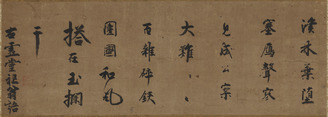
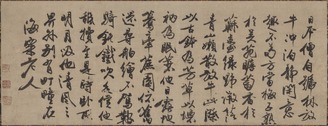
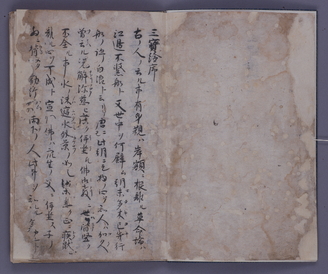
The full title is Unju-kokusaikokushi. The Emperor also granted his temple a wooden plaque “Tencho-unju-kosho-zenji.” Moreover, in the first year of the Shōhei era (1346), Emperor Go-Murakami of the Southern dynasty, son of Emperor Go-Daigo, granted Kohō another title of kokushi: Unjusanko-kokusaikokushi. Since Emperor Go-Murakami revered the priest and was eager to practice Zen, Kohō erected Daio-ji temple in Izumi (present-day Ōsaka) and served as its head priest. Throughout his life, Kohō stood beside the Southern dynasty until he passed away in the 16th year of the Shōhei era (1361) at the age of 91. In the first part of this calligraphic writing (from the beginning to the 9th line), the priest quoted an exchange between Mazu Daoyi, a Zen master during the Tang dynasty (618–907), and his disciple Dazhu Huihai. The passage from the 10th line was written for a female disciple called Hojudaishi (dates unknown). It emphasizes the importance of seeing things as they are without being biased by conceptual thinking. From the calligraphic style, it is assumed that Kohō wrote this work in his later years. The dynamic brushstrokes in changing ink shades attest to his powerful character. This is a rare and valuable work since apart from this, there are only two known calligraphic writings in Unju-ji temple in Shimane.
— Museum description: Kyushu National Museum (CC BY 4.0), via ColBase / Japan Search.