Important Cultural Property

Jar decorated in tri-color glaze
奈良三彩壺
Ceramics · Nara, 8th centuryKyushu NM
Home › Browse › Ceramics › Heian period › Green-glazed jar with four legs

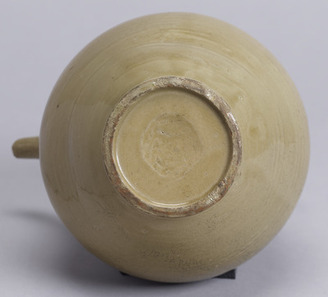
This green-glazed jar from the Sanage kiln has a short neck and four legs. The jar is made of soft white clay, which was shaped with a potter’s wheel into a noble and well-balanced form with a thin wall. The short mouth rim is slightly everted. The body is round with a marginally larger lower half and a flat base. Three horizontal convex lines decorated the shoulder, upper body and lower body of the jar. Four slightly thicker bisecting vertical lines extend from the shoulder to the base. The four lines are bent outwards at the ends and shaped with a spatula to resemble the legs of a beast. The green graze is applied all over the body and its effects maximized through the careful selection of the white clay. This clay is first fired before glazing. The generously applied green glaze gives the jar a glossy texture. Its bright and clear light color marked the epitome of Sanage glazing technology. This jar can be said to be of the representations of Heian period ceramics. During the Heian period, Sanage, situated in the mid-western part of Aichi (covering the area from present day Nagoya to Miyoshi), was a production center of the finest gray and green glazed ware in Japan.
This four-legged jar was modeled after the four-legged celadon jars of the Yuezhou kiln in China. Chinese celadon ware, however, is smaller in size and has only vertical convex lines. During the mid-9th century, potters in Sanage developed gray and green glazed ware. Most of these were used as cremation urns. Although Sanage potters initially produced small jars with only vertical lines similar to the Yuezhou kiln celadon jars, they subsequently began to produce larger jars with both vertical and horizontal lines like this example. The kiln stopped producing such four-legged green-glazed jars in the early 10th century. This four-legged jar is believed to have been unearthed from Mt. Kozui-san (previously known as Mt. Hensho-san) in Akaze, Haibara town, Uda county, Nara. It was deduced that the jar was used as a cremation urn.
— Museum description: Kyushu National Museum (CC BY 4.0), via ColBase / Japan Search.