Important Cultural Property
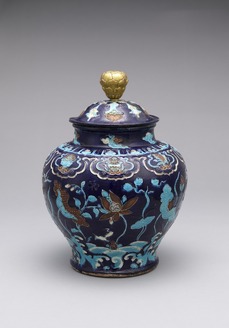
Lidded fahua jar depicting herons and lotuses
法花蓮鷺文有蓋壺
Ceramics · Muromachi, 1401–1600Kyushu NM
Home › Browse › Ceramics › Kamakura period › Tea bowl (yuteki tenmoku type)
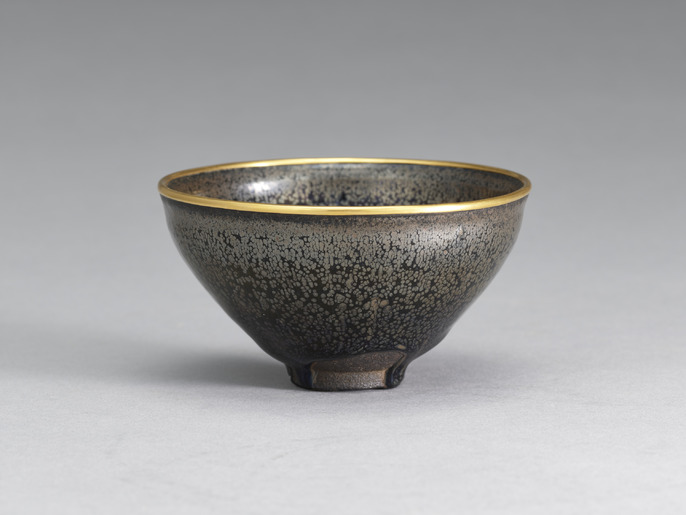
This object has the typical shape of the tenmoku tea bowl in the Kensan style (tea bowls produced in the Jian kiln in China). This bowl rim tucks inward and then expands outwards (suppon-guchi). The upper half of the body swelling slightly and then tapers at the bottom. The foot is low and small, and its inside is scraped shallowly flat. The tea bowl is made of dark gray clay with high iron content and low impurity levels. It is fired at a high temperature to make the finished product hard. Jet-black glaze is viscously and thickly applied and the section around the bottom is left unglazed. Small oil spots emerged densely both inside and outside the bowl covered by jet-black glaze. These irregular silver oil spots with a slightly bluish hue are a unique feature of tenmoku glaze. As a production center of such oil-spot tenmoku ware, the Jian kiln in Jianyang-xian county, Fujian-sheng province, China, is the most famous. This piece has a perfect form and beautiful glaze with oil-spot like patterns. Another oil-spot tenmoku tea bowl that matches this piece in Japan has been designated a National Treasure and is in the collection (previously belonged to the Sakai family) of the Museum of Oriental Ceramics, Osaka.
The Kuntaikansōchōki from the Muromachi period (1338–1572) recorded the interior decoration of the salon of the Shōgun. It records that the imported Chinese tea caddies, tea bowls, and other utensils were used at tea ceremonies, and to embellish the room. The book ranks yohen tenmoku at the highest place for tea bowls and oil-spot tenmoku the second. On the inner wooden box cover of this tea bowl, “yuteki (oil-spot)” is written in hiragana. This may be attributed either to Sen no Rikyu or Furuta Oribe, both being celebrated masters of tea ceremony. The tea bowl then came into the possession of Doi Toshikatsu and Kinoshita Chozon. In the late Edo period (1603–1868), it was owned by Matsudaira Fumai, a feudal lord cum master of tea ceremony. The Chinese characters inscription meaning “yuteki” was written on the outer box cover by Matsudaira Fumai himself.
— Museum description: Kyushu National Museum (CC BY 4.0), via ColBase / Japan Search.