Important Cultural Property
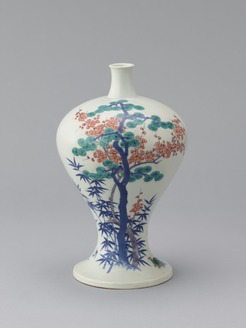
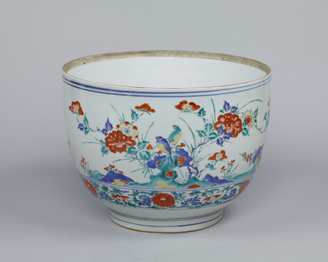
Wine jar depicting a pine tree, a plum tree, and bamboo in overglaze enamels
色絵松竹梅文瓶子
Ceramics · Edo, 17th centuryKyushu NM
Home › Browse › Ceramics › Edo period › Large dish depicting wisteria arbors in overglaze enamels
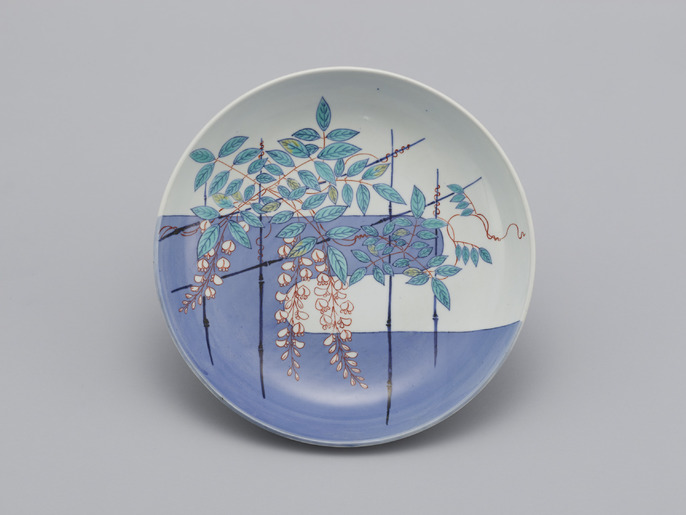
This large dish depicts white wisteria blossoms hanging down the bamboo trellis and swaying in a breeze against the backdrop of clouds. Inside the dish, the clouds are portrayed through capitalizing the upper blank portion by the contouring of the lower portion with cobalt blue under glaze painting (dami technique) while thinly and evenly glazing the contoured area (sometsuke). The bamboo trellis is drawn in six lines of sometsuke, with the wisteria leaves contoured in sometsuke and painted in green. A yellow glaze has been added to the tips of a few leaves. The flowers are outlined in red, with the white color of the porcelain body left unglazed. Vines and stems are also drawn in red. The external surface of the dish has three motifs of interlinked circles and ribbons. Thin vertical lines are arranged around the foot. This dish is classified as Iro-Nabeshima or overglaze porcelain produced in the official kiln of Nabeshima domain in Hizen province (present-day Saga). After the establishment of the Tokugawa shogunate government (1603), the Nabeshima domain offered Chinese porcelains as tributes to the successive generations of shoguns. When imports ceased due to the turmoil around the end of the Ming dynasty (1368–1644) and the beginning of the Qing dynasty (1644–1912) in China, the Nabeshima domain began to produce porcelains domestically. After establishing its first official kiln in Iwayagawachi in Arita during the Kanei era (1624–44), the domain opened Okawauchiyama kiln in Imari.
Some suggested that before this, the domain founded another kiln known as Nan-gawarayama, which produced Kakiemon-style porcelains. Since these kilns exclusively produced the highest-quality porcelains to offer to the shoguns, feudal lords, and court nobles, the kiln was rigorously managed by the domain government. The shapes, designs and techniques were standardized, and the best quality was sought at any cost. Dishes were the main tribute items. They were designed with a high foot and deep bowl-like shape known as mokuhaigata (form of wooden sake cups). The basic dish sizes were at 1 shaku (about 30 cm), 7 sun (about 21 cm), and 5 sun (about 15 cm). Although the domain is believed to annually offer up about 2,000 porcelain objects, there were only two dishes of 1 shaku among them. Accordingly, this dish with a diameter of more than 30 cm is priceless. The dish has features typical to Nabeshima ware—mokuhaigata shape, designs of interlinked circles and ribbons on the external surface, and the foot decorated with a comb-line pattern. While the dish has an elegant and sophisticated atmosphere that befits a tribute to the Shōgun, it also evokes a serene and balmy breeze blowing against the backdrop of the blue sky of early summer.
— Museum description: Kyushu National Museum (CC BY 4.0), via ColBase / Japan Search.